
Steve Benford, John Bowers, Lennart E. Fahlén, Chris Greenhalgh and Dave Snowdon
Department of Computer Science
The University of Nottingham, Nottingham, UK
Tel: +44-602-514203
E-mail: sdb@cs.nott.ac.uk
Department of Psychology
The University of Manchester, Manchester, UK
Tel: +44-61-275-2599
E-mail: bowers@hera.pych.man.ac.uk
The Swedish Institute of Computer Science
Stockholm, Sweden
Tel: +46-8-752-1539
E-mail: lef@sics.se
Department of Computer Science
The University of Nottingham, Nottingham, UK
Tel: +44-602-514225
E-mail: cmg@cs.nott.ac.uk
Department of Computer Science
The University of Nottingham, Nottingham, UK
Tel: +44-602-514225
E-mail: dns@cs.nott.ac.uk
This paper explores the issue of user embodiment within collaborative virtual environments. By
user embodiment we mean the provision of users with appropriate body images so as to represent
them to others and also to themselves. By collaborative virtual environments we mean multi-user
virtual reality systems which explicitly support co-operative work (although we argue that the
results of our exploration may also be applied to other kinds of collaborative system). The main
part of the paper identifies a list of embodiment design issues including: presence, location,
identity, activity, availability, history of activity, viewpoint, actionpoint, gesture, facial
expression, voluntary versus involuntary expression, degree of presence, reflecting capabilities,
physical properties, active bodies, time and change, manipulating your view of others,
representation across multiple media, autonomous and distributed body parts, truthfulness and
efficiency. Following this, we show how these issues are reflected in our own DIVE and
MASSIVE prototype systems and also show how they can be used to analyse several other
existing collaborative systems.
This paper presents an early theoretical exploration of this issue based
on our experience of constructing and analysing a variety of collaborative virtual environments:
multi-user virtual reality systems which support co-operative work.
The motivation for embodying users within collaborative systems becomes clear when one
considers the role of our bodies in everyday (i.e. non-computer supported) communication. Our
bodies provide immediate and continuous information about our presence, activity, attention,
availability, mood, status, location, identity, capabilities and many other factors. Our bodies may
be explicitly used to communicate as demonstrated by a number of gestural sign languages or
may provide an important accompaniment to other forms of communication, helping co-ordinate
and manage interaction (e.g. so called "body language").
In our experience, user embodiment becomes an obviously important issue when designing
collaborative virtual environments, probably due to their highly graphic nature and the way in
which designers are given a free hand in creating objects. However, we believe that many of the
issues we raise are equally relevant to co-operative systems in general, where embodiment often
seems to be a neglected issue (it appears that many collaborative systems still view users as
people on the outside looking in). To go a stage further, we argue that without sufficient
embodiment, users only become known to one another through their (disembodied) actions; one
might draw an analogy between such users and poltergeists, only visible through paranormal
activity. The basic premise of our paper is therefore that the inhabitants of
collaborative virtual environments (and other kinds of collaborative system) ought to be directly
visible to themselves and to others through a process of direct and sufficiently rich
embodiment. The key question then becomes how should users be embodied? In other
words, are the body images provided appropriate to supporting collaboration? Furthermore, as
opposed to merely discussing the appearance of virtual body, we also need to focus on its
functions, behaviours and its relation to the user's physical body (i.e. how is the body
manipulated and controlled?). Thus, an embodiment can be likened to a 'marionette' with active
autonomous behaviours together with a series of strings which the user is continuously 'pulling'
as smoothly as possible.
Our paper therefore aims to identify a set of design issues which should be considered by the
designers of virtual bodies, along with a set of techniques to support them. These are listed in
section two and constitute a diverse, and occasionally conflicting, set of requirements. Designing
an appropriate body image will most likely be a case of maintaining a sensible balance between
them. Furthermore this balance may be both application and user dependent and will no doubt be
constrained by the available computing resources. In the long term it may be possible to refine
our initial list of issues into a 'body builder's work-out'. However, we do not yet have sufficient
experience to do this. Instead, in section three we describe how the issues are currently reflected
in two of our own collaborative virtual environments, DIVE and MASSIVE, giving examples of
the bodies we have constructed so far. Section four then uses our list as a framework for
analysing how a variety of other collaborative virtual environments and more general CSCW
systems tackle user embodiment.
In this section we identify a list of design issues for user embodiments as well as possible
techniques for dealing with them. As indicated above, we approach these issues from the
perspective of collaborative virtual environments, although we encourage the reader to consider
their application to other kinds of collaborative system. We begin with the fundamental issues of
presence, location and identity.
Allowing users to personalise body images is also
likely to be important if collaborative virtual environments are to gain widespread acceptance.
Such personalisation allows people to create recognisable body images and may also help them
to identify with their own body image in turn. An example of personalisation might be the ability
to don virtual garments or jewellery. Clearly, this ability might have a broader social significance
by conveying status or associating individuals with some wider social group (i.e. cultural and
work dress codes or fashions).
A viewpoint represents where in space a person is attending and is closely related to the
notion of gaze direction (at least in the visual medium). Understanding the viewpoints of others
may be critical to supporting interaction (e.g. in controlling turn-taking in conversation or in
providing additional context for interpreting talk, especially when spatial-deictical expressions
such as 'over there' or 'here' are uttered). Furthermore, humans have the ability to register the
rapidly changing viewpoints of others at a fine level of detail (i.e. tracking the movement of
other's eyes even at moderate distances). Previous experimental work in the domain of
collaborative three dimensional design has already shown the importance of conveying users'
viewpoints [8]. In contrast, an actionpoint represents where in space a person is manipulating.
Actionpoints typically correspond to the location of virtual limbs (e.g. a telepointer representing
a mouse or the image of a hand representing a data glove).
We propose that a user may possess multiple actionpoints and viewpoints. Notice that we
deliberately separate where people are attending from where they are manipulating. Although
these are often closely related, there appears to be no reason for insisting that they are strictly
synchronised; in the real world it is quite possible to manipulate a control while attending
somewhere else indeed, this is highly desirable when driving a car! Representing actionpoints
involves providing an appropriate image of a limb driven by whatever device a user is
employing. Representing viewpoint involves tracking where a user is attending and moving
appropriate parts of their embodiment. Later on we shall see systems that show general body
position, head position or even eye position depending on the power of the tracking facilities in
use.
As a concrete example of this issue, we cite some of our early experiences with the DIVE system
(see below). One of the interesting aspects of DIVE is that a user process that exits unexpectedly
often leaves behind a 'corpse' (an empty graphics embodiment). A long DIVE session may
produce several such corpses (particularly when developing and testing new applications), which
can cause confusion. As a result, two informal conventions have been established among DIVE
users. First, on meeting a stationary embodiment, one grabs it and gives it a shake (DIVE allows
you to pick other people up). An angry reaction tells you that the embodiment is occupied.
Second, bodies that turn out to be corpses are 'buried' (i.e. moved) below the ground plane. It
would be useful to have some more graceful mechanisms for dealing with this problem!
This discussion of gesture and facial expression relates to a further issue, that of voluntary versus
involuntary expression. Real bodies provide us with the ability to consciously express ourselves
as a supplement or alternative to other forms of communication. Virtual bodies can support this
by providing an
appropriate set of limbs and 'strings' with which to manipulate them. The more flexible the limbs;
the richer the gestural language. However, we suspect that users may find ways of gesturing with
even very simple limbs. On the other hand, involuntary expression (i.e. that over which users
have little control) is also important (looks of shock, anger, fear etc.). However, support for this
is technically much harder as it requires automatic capture of sufficiently rich data about the user.
This is the real problem we are up against with the facial expression issue - how to capture
involuntary expressions.
This requirement poses a serious problem for most of today's multi-user VR systems - that of
subjective variability. Current systems are highly objective in their world view. In other words,
all observers see the same world (albeit from different perspectives). A notable exception in this
regard is the VEOS system [3]. The ability for people to adopt subjective world views (e.g.,
seeing different representations of an embodiment) represents a challenge to current VR
architectures.
In summary, we have proposed a list of design issues that need to be considered by the designers
of virtual bodies along with some possible techniques for addressing them. The following section
now describes how some of these issues have been dealt with in our own DIVE and MASSIVE
prototype collaborative virtual environments.
A variety of embodiments have been implemented within the DIVE system. The simplest are the
'blockies' which are composed from a few basic graphics objects. The general shape of blockies
is sufficient to convey presence, location and orientation (the most common example being a
letter 'T' shape). In terms of identity, simple static cartoon-like facial features suggest that a
blockie represents a human and the ability for people to personalise their own body images
supports some differentiation between individuals (DIVE provides a general geometry
description language with which users may specify their own
body shapes if they wish). A more advanced DIVE body for immersive use texture maps a static
photograph onto the face of the body, thus providing greater support for identifying users in
larger scale communication scenarios. This body also provides a graphic representation of the
user's arm which tracks their hand position in the physical world via a 3-D mouse.
The display of a solid white line extending from a DIVE body to the point of manipulation in
space represents actionpoint in a simple and powerful way and enables other users to see what
actions a user is engaged in (e.g., selecting objects). In various DIVE data visualisation
applications, each user may also be associated with a different colour which is used to show
which data they are accessing (selected objects change to this colour), thereby providing limited
peripheral awareness of their activity. Immersive blockies also support a moving head which
tracks the position of the user's head in the real world via their head-mounted display (i.e. a six
degrees of freedom sensor attached to the top of the user's head). This is very effective at
conveying viewpoint, general activity and degree of presence. Finally, video conferencing
participants can be represented in DIVE through a video window.
FIGURE 1, "various embodiments attend a DIVE conference", shows a DIVE conference
scenario involving a range of embodiments. From left to right we see: an immersed user with
humanoid body, textured face and tracked head and arm; a simple non-immersive blockie
sporting a humorous propeller hat; a video conferencing participant; and a second immersive
user. The scene also shows some DIVE collaboration support tools: a functioning whiteboard
which can also be used to create documents and a conference table for document distribution.
FIGURE 1.
Various embodiments attend a DIVE conference
MASSIVE supports multiple virtual worlds connected via portals. Each world may be inhabited
by many concurrent users who can interact over ad-hoc combinations of graphics, audio and text
interfaces. The graphics interface renders objects visible in a 3-D space and allows users to
navigate this space with a full six degrees of freedom. The audio interface allows users to hear
objects and supports both real-time conversation and playback of pre-programmed sounds. The
text interface provides a MUD (Multi-User Dungeon)-like view of the world via a window (or
map) which looks down onto a 2-D plane across which users move. Text users are embodied
using a few text characters and may interact by typing messages to one another or by 'emoting'
(e.g. smile, grimace, etc.).
The graphics, text and audio interfaces may be arbitrarily combined according to the capabilities
of a user's terminal equipment. Furthermore, users may export an embodiment into a medium
that they cannot receive themselves (thus, a text user can be made visible in the graphics medium
and vice versa). The net effect is that users of radically different equipment may interact, albeit in
a limited way, within a common virtual world (e.g. text users may appear as slow-speaking, slow
moving flatlanders to graphics users). For example, at one extreme, the user of a sophisticated
graphics workstation may simultaneously run the graphics, audio and text clients (the latter
providing a map facility and allowing interaction with non-audio users). At the other, the user of
a dumb terminal (e.g. a VT-100) may run the text client alone. It is also possible to combine the
text and audio clients without the graphics and so on. One effect of this heterogeneity is to allow
us to populate MASSIVE with large numbers of users at relatively low cost.
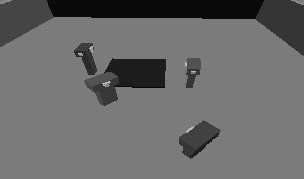
MASSIVE graphics embodiments are based on DIVE blockies (although, as with DIVE, users
can specify their own geometry via a simple modelling language). Blockies are also
automatically labelled with the name of their owner so as to aid identification. In the text
interface, users are embodied by a single character (typically the first letter of their chosen name)
which shows position and may help identify users in a limited way. An additional line (single
character) points in the direction the user is currently facing. Thus,
using only two characters, MASSIVE's text interface conveys presence, location, orientation and
identity.
Given MASSIVE's inherent heterogeneity, its embodiments need to convey users' capabilities to
one another. For example, considering the graphics interface, an audio capable user has ears; a
desk-top graphics user (monoscopic) has a single eye; an immersed stereo user would have two
eyes and a text user ('textie') has the letter 'T' embossed on their head. Thus, on meeting another
user, it should be possible to quickly work out how they perceive you and through which media
you can communicate with them (e.g., should you use audio or send text?). FIGURE 2, "users
show their capabilities at a MASSIVE conference", shows an example of the graphics interface
showing a conference involving five users (the figure shows the view of one of them). We see
two non-immersed, audio capable users facing each other across the conference table (ears and a
single eye) and a text-only user facing diagonally towards us. We can also see that another non-
audio capable user has their back to us.
FIGURE 2.
Users show their capabilities at a MASSIVE conference
Abstract
Keywords:
virtual reality, CSCW, embodiment
Introduction
User embodiment concerns the provision of users with appropriate body images so as to
represent them to others (and also to themselves) in collaborative situations. DESIGN ISSUES AND TECHNIQUES
Presence
The primary goal of a body image is to convey a sense of someone's presence in
a virtual environment. This should be done in an automatic and continuous way so that other
users can tell 'at a glance' who is present. In a visually oriented system (such as most VR
systems) this will involve associating each user with one or more graphics objects which are
considered to represent them.
Location
In shared spaces, it may be important for an embodiment to show the location of a user. This may
involve conveying both position and orientation within a given spatial frame of reference (i.e. co-
ordinate system). We argue that conveying orientation may be particularly important in
collaborative systems due to the significance of orientation to everyday interaction. For example,
simple actions such as turning one's back on someone else are loaded with social significance.
Consequently, it will often be necessary to provide body images with recognisable front and back
regions.
Identity
Recognising who someone is from their embodiment is clearly a key issue. In fact, body images
might convey identity at several distinct levels of recognition. First, it could be easy to recognise
at a glance that the body is representing a human being as opposed to some other kind of object.
Second, it might be possible to distinguish between different individuals in an interaction, even if
you don't know who they are. Third, once you have learned someone's identity, you might be
able to recognise them again (this implies some kind of temporal stability). Fourth, you might be
able to find out who someone is from their body image. Underpinning these distinctions is the
time span over which a body will be used (e.g. one conversation, a few hours or permanently)
and the potential number of inhabitants of the environment (from among how many people does
an individual have to be recognised?). Activity, viewpoints and actionpoints
Body images might convey a sense of on-going activity. For example, position and orientation in
a data space can indicate which data a given user is currently accessing. Such information can be
important in co-ordinating activity and in encouraging peripheral awareness of the activities of
others. We identify two further aspects of conveying activity: representing user's viewpoints and
representing their actionpoints. Availability and degree of presence
Related to the idea of conveying activity is the idea of showing availability for interaction. The
aim here is to convey some sense of how busy and/or interruptable a person is. This might be
achieved implicitly by displaying sufficient information about a person's current activity or
explicitly through the use of some indicator on their body. This leads us to the further issue of
degree of presence. Virtual reality can introduce a strong separation between mind and body. In
other words, the presence of a virtual body strongly suggests the presence of the user when this
may not, in fact, be the case (e.g., the mind behind the body may have popped out of the office
for a few seconds). This is particularly likely to happen with 'desktop' (i.e. screen-based VR)
where there is only a minimal connection between the physical user and their virtual body. This
mind/body separation could cause a number of problems such as the social embarrassment and
wasted effort involved in one person talking to an empty body for any significant amount of
time. As a result, it may be important to explicitly show the degree of actual presence in a virtual
body. For example, the system might track a user's idle time and employ mechanisms such as
increasing translucence or closing eyes to suggest decreasing presence. It might also be possible
to put one's body into a suspended state, indicating partial presence to others and perhaps
recording on-going conversation to be replayed when subsequently woken up. A suspended body
would therefore act as a marker through which one could try to contact its owner in the external
world . Gesture and facial expression
Gesture is an important part of conversation and ranges from almost sub-conscious
accompaniment to speech to complete and well formed sign languages for the deaf. Support for
gesture implies that we need to consider what kinds of 'limbs' are present. Facial expression also
plays a key role in human interaction as the most powerful external representation of emotion,
either conscious or sub-conscious. Facial expression seems strongly related to gesture. However,
the granularity of detail involved is much finer and the technical problems inherent in its capture
and representation correspondingly more difficult. A crude, but possibly effective approach,
might be to texture map video onto an appropriate facial surface of a body image (e.g. the
"Talking Heads" at the Media Lab [2]). Another approach involves capturing expression
information from the human face using an array of sensors on the skin, modelling it and
reproducing it on the body image (e.g. the work of ATR where they explicitly track the
movement of a user's face and combine it with models of facial muscles and skin [6] and also the
work of Thalmann [10] and Quéau [7]).History of activity
Embodiments might support historical awareness of past presence and activity. In other words,
conveying who has been present in the past and what they have done. Clearly we are extending
the meaning of 'body' beyond its normal use here. An example might be carving out trails and
pathways through virtual space in much the same way as they are worn into the physical world.
Manipulating one's view of other people
In heterogeneous systems where users might employ equipment with radically different
capabilities (see MASSIVE below), it will be important for the observer to be able to control
their view of other people's bodies. For example, as the user of a sophisticated graphics
computer, I may have the processing power to generate a highly complex and fully-textured
embodiment. However, this is of little benefit to an observer who does not have a machine with
hardware texturing support. Indeed, the complexity of my body would be counter-productive as
the observer would be forced to expend valuable computing resource on rendering my body
when it could better be used to render other objects. As a result, the observer should be able to
exert some influence over how other people appear to them, perhaps selecting from among a set
of possible bodies the one that most suits their needs and capabilities. In short, we propose that it
is important for the both the owner and the observers of an embodiment to control how it
appears.Representation across multiple media
Up to now we have spoken mainly in terms of visual body images. However, body images will
be required in all available communication media including audio and text. For example, audio
body images might centre around voice tone and quality, be it that of the real-person or be it
artificial. Text body images (as used in multi-user dungeons) might involve text names and
descriptions or (in a collaborative authoring application) a text-body's 'limbs' might be
represented by familiar word processing tools and icons (cursor, scissors etc.).
Autonomous and distributed body parts
We have discussed virtual bodies as if they are localised within some small region of space. We
may also need to consider cases where people are in several places at a time, either through
multiple direct presence (e.g. logging on more than once) or through some kind of computer agent
acting on their behalf (e.g. issuing a database query while browsing an information visualisation).
Efficiency
There will always be a limit to available computing and communications resources. As a result,
embodiments should be as efficient as possible, by
conveying the above information in simple ways. More specifically, we suspect that approaches
which attempt to reproduce the human physical form in as full detail as possible may in fact be
wasteful and that more abstract approaches which reflect the above issues in simple ways may be
more appropriate. Furthermore, we need to support 'graceful degradation' so that users with less
powerful hardware or simpler interfaces can obtain sufficiently useful information without being
overloaded. This suggests prioritising the above issues in any given communication scenario. In
fact, the real challenge with embodiment will be to prioritise the issues listed in this section
according to specific user and application needs and then to find ways of supporting them within
a limited computing resource.
Truthfulness
This final issue relates to nearly all of those raised above. It concerns the degree of truth of a
body image. In essence, should a body image represent a person as they are in the physical world
or should it be created entirely at the whim or fancy or its' owner? We should understand the
consequences of both alternatives, or indeed of anything in between. Examples include: truth
about identity (can people pretend to be other people?}; truth about facial expression (imagine a
world full of perfect poker players); and truth about capabilities (this body has ears on, can they
hear me?) On the one hand, lying can be dangerous. On the other, constraining people to the
brutal physical truth may be too limiting or boring. The solution may be to specify a gradient
of body attributes that are increasingly difficult to modify. Those that are easy require
relatively little resource. Those that are not require more. For example, changing virtual garments
might be easy whereas changing size or face of voice might be difficult. Truthfulness may also
be situation dependent (i.e. different degrees may be required for different worlds, applications,
contexts etc.). For example, simulation type VR applications may require a very high level of
truthfulness.EMBODIMENT IN DIVE AND MASSIVE
The authors have been involved in the construction of two general collaborative virtual
environments, DIVE at the Swedish Institute of Computer Science, and MASSIVE at the
University of Nottingham. This section considers how the above design issues are reflected in
these systems.
Embodiment in DIVE
Virtual reality research at the Swedish Institute of Computer Science has concentrated on
supporting multi-user virtual environments over local- and wide-area computer networks, and the
use of VR as a basis for collaborative work. As part of this work, the DIVE (Distributed
Interactive Virtual Environment) system has been developed to enable experimentation and
evaluation of research results [4]. The DIVE system is a tool kit for building distributed VR
applications in a heterogeneous network environment. In particular, DIVE allows a number of
users and applications to share a virtual environment, where they can interact and communicate
in real-time. Audio and video functionality makes it possible to build distributed video-
conferencing environments enriched by various services and tools. Embodiment in MASSIVE
MASSIVE (Model, Architecture and System for Spatial Interaction in Virtual Environments) is a
VR conferencing system which realises the COMIC spatial model of interaction [1]. The main
goals of MASSIVE are scale (i.e. supporting as many simultaneous users as possible) and
heterogeneity (supporting interaction between users whose equipment has different capabilities,
who employ radically different styles of user interface and who communicate over an ad-hoc
mixture of media).4. EMBODIMENT IN OTHER SYSTEMS
Next, we briefly analyse the embodiments provided by four further existing technologies,
matching them up to the issues identified previously. The four technologies are: dVS, the
commercial VR system from DIVISION; ATR's Collaborative Workspace; the multi-user VR
game, Doom; and the general use of video as a communication medium. These specific examples
have been chosen because of their diversity and because they highlight some interesting aspects
of embodiment. Given more space, a wide range of other applications might also have been
considered. Indeed, our intention is that designers of future collaborative applications could
perform a similar exercise to the following and so gauge the likely effectiveness and limitations
of their proposed body images for co-operative work. In order to save space, we only discuss
those issues that are actually supported by the chosen examples.
dVS
dVS, from DIVISION Ltd, has been chosen as a typical example of current commercially
available VR systems [5]. dVS supports multi-user virtual reality applications running on both
DIVISION's own hardware and on Silicon Graphics machines. Users may operate in either
immersive or desktop modes. The default embodiment in dVS is a telepointer, although the
authors have seen examples involving a disembodied head and a single limb. dVS addresses the
following design issues:
Collaborative Workspace
The ATR lab has been exploring the use of virtual reality to support co-operative work for some years
[9]. The main thrust of their research has
been on supporting two-party teleconferencing and, in particular, on automatically capturing and
reproducing facial expressions. Their collaborative workspace prototype achieves this by
attaching a video camera to a head-mounted frame which also supports a position tracker. The
use of small reflective disks
attached to the user's face allows automatic analysis of their facial movements from the video
image. This is then used to animate a texture mapped model of the user's face. Collaborative
workspace addresses the following issues:
Complimentary, and equally impressive, work on the capture and
reproduction of facial expressions has been reported by Thalmann [10]. In this case, the user is not
constrained to wearing a head-mounted camera or any facial 'jewellery' or special make-up. The
advantage of this is clearly a lack of intrusiveness. However, the disadvantage appears to be the
inability to combine facial expressions with head tracking.
Doom
Doom is a multi-user virtual reality game for networked PCs. Doom has been chosen as a
representative VR entertainment application intended for mass use and also because it supports
many embodiment issues within very limited computing resources. Doom allows up to four users to
navigate through a maze of corridors and rooms killing everything that they meet using a variety of
weapons. The multi-user version can either be played in death-match mode (i.e. scoring points for
killing each other) or, most interestingly, in co-operative mode (i.e. scoring points for killing other
things together). Although this may seem far removed from a useful co-operative system, Doom
contains several features worth noting. First, the graphics in Doom realise navigable texture mapped
environments on a 486 platform. In order to achieve this level of graphics performance, the
designers of Doom have placed some constraints on their virtual worlds such as restricting them to
use only perpendicular surfaces. Indeed, this is what makes the issue of embodiment in Doom
particularly interesting; efficiency is of very great importance. Doom addresses the following design
issues:
Video
The use of video in collaborative applications is becoming increasingly widespread and makes an
interesting contrast to the above VR based examples. As opposed to considering any specific video
conferencing system, we focus on the nature of embodiment within video as a general medium.